
What are case packers? #
Case packers are essential machines for automating secondary packaging. Their purpose is to group products coming from the production line and place them into cases accurately, quickly and safely.
Integrating an automatic case packer helps eliminate bottlenecks associated with manual handling, improving production continuity and ensuring consistent quality over time.
At Duetti Packaging, we develop solutions that can be adapted to different product types, containers and line speeds.
Types of case packers #
Different case-packing technologies are available depending on the type of packaging used and the product loading method.
Wrap-around case packers #
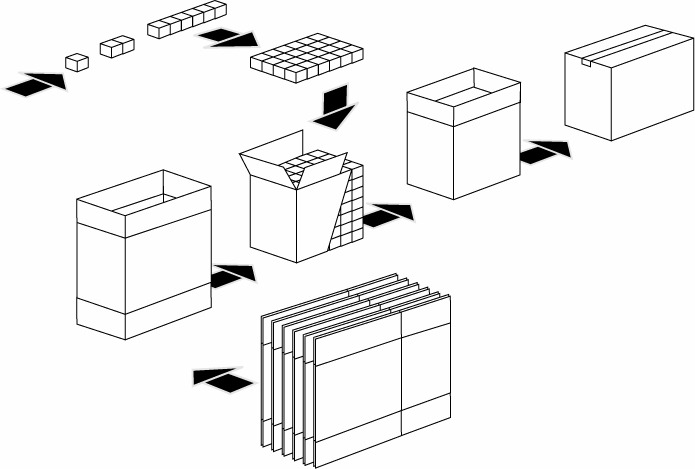
Wrap-around case packers form the package from a flat die-cut cardboard blank that is wrapped directly around the product. These machines can also produce trays.
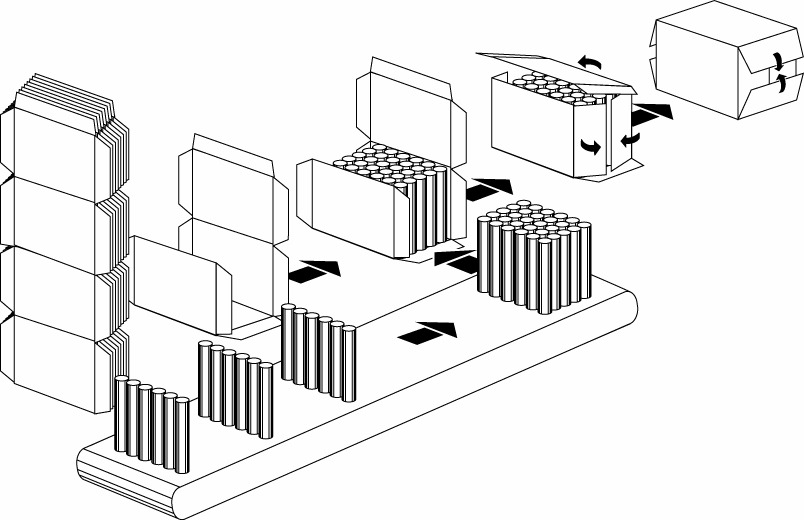
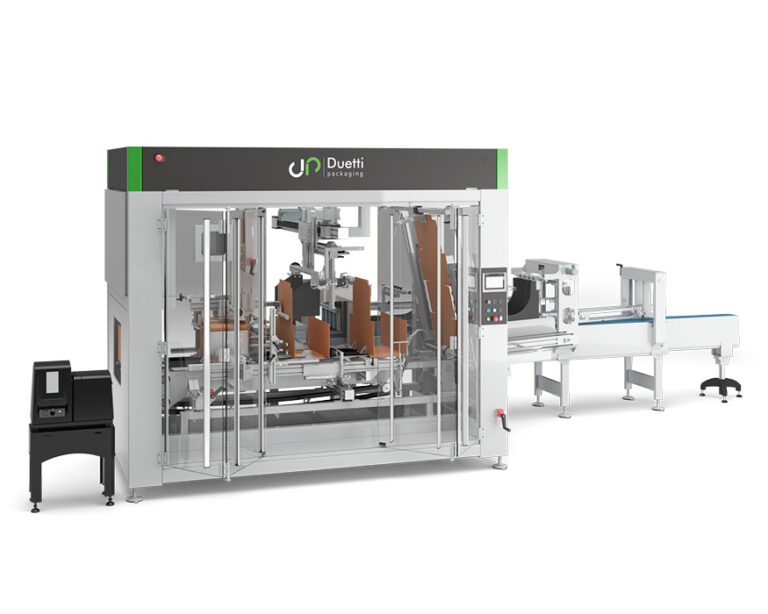
The process includes:
- case forming;
- product insertion;
- closing with hot-melt adhesive.
The process takes place through successive stations — forming, insertion and closing — ensuring precision and control at every stage of the cycle.
Why choose them? #
Wrap-around case packers are particularly suitable when compact, strong packaging with optimized material usage is required.
Compared with other solutions, they can reduce the amount of packaging material used thanks to die-cut blanks with optimized thicknesses and geometries designed around the product.
Main advantages:
- greater compression resistance;
- reduced material usage;
- compact and optimized packaging;
- high forming accuracy;
- high efficiency on high-output production lines.
Duetti Packaging solutions: WRAP 10, WRAP 12 and WRAP 18 series.
How a wrap-around case packer works #
The operating cycle is controlled by a PLC and follows a precise sequence.
1. Forming #
The die-cut blank is picked from the magazine by a suction-cup arm and positioned on an indexing system. The system then performs a first indexing movement, positioning the partially formed package in front of the insertion station.
2. Feeding and grouping #
Products arrive on conveyor belts and are arranged according to the required packing pattern.
3. Insertion #
The product is transferred laterally into the package by a dedicated loading head. The system then performs a second indexing movement, preparing the package for closing.
Hot-melt adhesive is applied during the transfer to the closing station.
4. Closing #
The flaps are folded and the case is sealed with hot-melt adhesive. The system then performs a final indexing movement, after which the completed package exits the machine.
Top-loading RSC case packers #
RSC case packers use pre-glued Regular Slotted Containers, widely used because of their simplicity and flexibility.
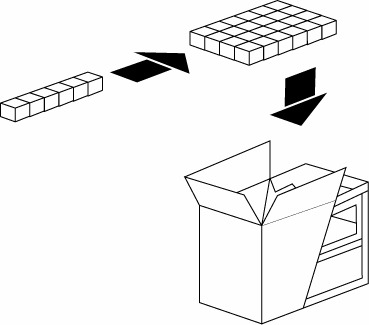
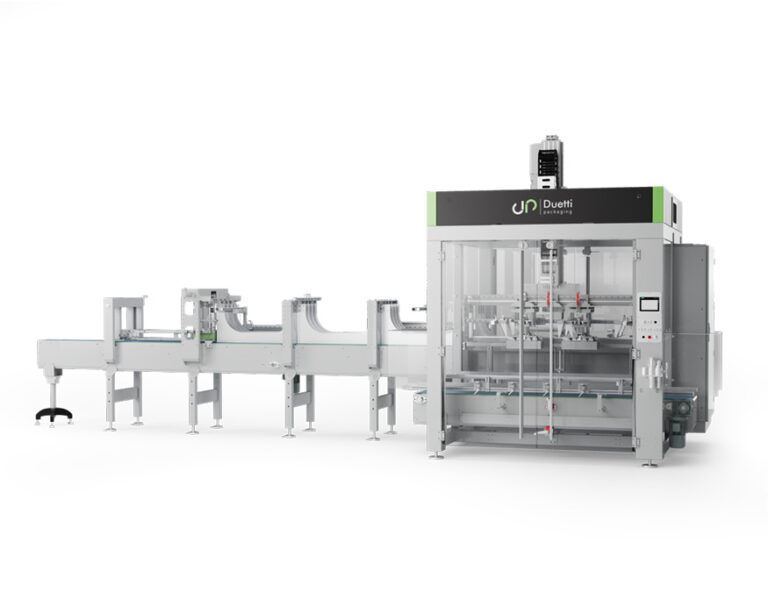
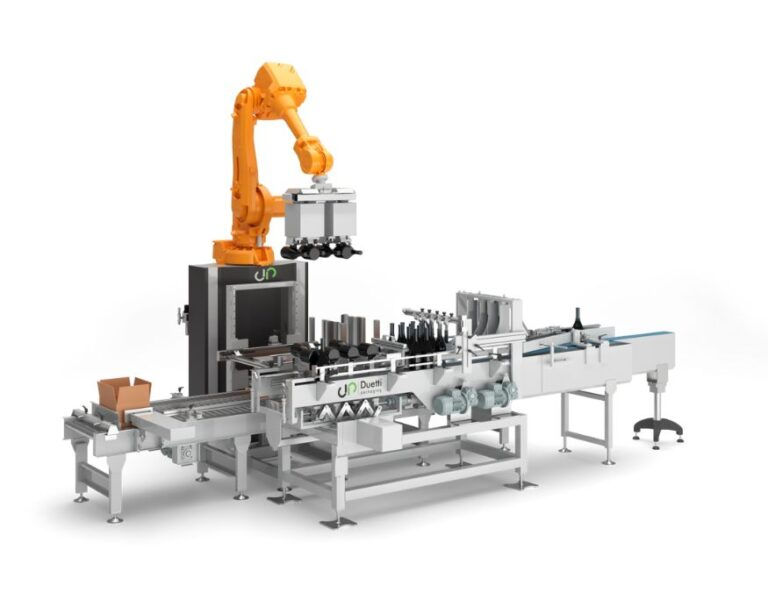
In top-loading systems, products are inserted into the case from above.
These solutions can be configured either as standalone case-packing modules or as all-in-one monoblock systems.
This solution is ideal for:
- bottles;
- containers;
- jars;
- fragile products;
- containers requiring precise and controlled insertion.
Duetti Packaging standalone case-packing solutions:
- PACKER 10–20 series
- FLEX-ROBOT series, with articulated robots for complex configurations, such as tête-bêche arrangements.
All-in-one top-loading monoblock systems #
All-in-one top-loading monoblock systems integrate all the main process stages into a single machine:
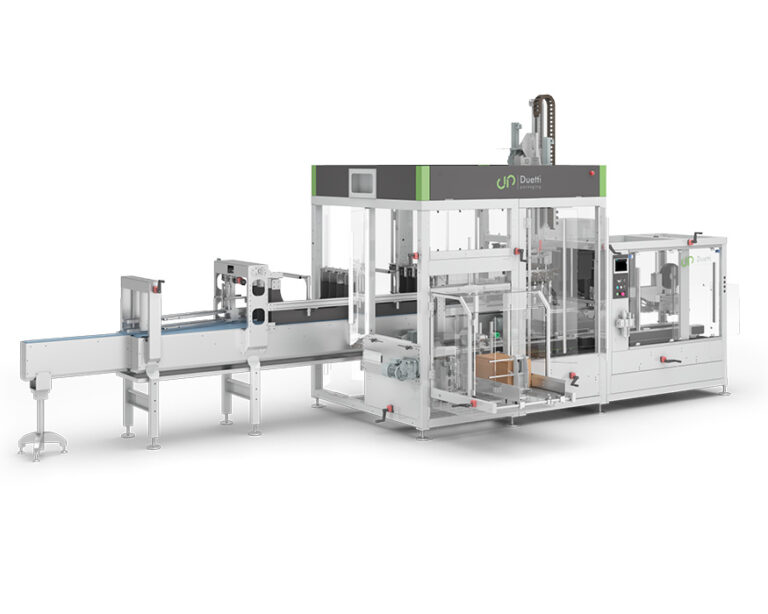
- case forming;
- top loading of the product;
- case closing..
They are particularly suitable when floor space is limited or when several functions need to be combined in one compact machine.
Duetti Packaging solutions: MULTIPACKER series.
How a top-loading case-packing module works #
The process is simple and efficient.
- Feeding and grouping
Products arrive on conveyor belts and are arranged by product grouping systems according to the required packing pattern. - Insertion
The products are picked and inserted into the case from above using a dedicated loading head. A centering system positions the case correctly, making the insertion process easier and more reliable.
In all-in-one top-loading systems, the process also includes case forming and closing.
- Forming
The case blank is picked from the magazine by suction cups and erected, ready for loading. - Feeding and grouping
Products arrive on conveyor belts and are arranged by product grouping systems according to the required packing pattern. - Insertion
The products are picked and inserted into the case from above using a dedicated loading head. A centering system positions the case correctly, making the insertion process easier and more reliable. - Closing
The flaps are folded and the case is sealed using hot-melt adhesive or adhesive tape.
Advantages of automatic case packing #
Automating end-of-line packaging delivers tangible benefits.
- Reduced operating costs
Less labour required for repetitive and physically demanding tasks. - Increased productivity
Consistent cycles and continuous operation, even over multiple shifts. - Greater safety and ergonomics
Elimination of manual load handling. - Production continuity
Reduced dependence on operator availability.
How to choose the right case packer #
The choice depends on several key factors.
1. Production requirements #
- production volumes and line speed;
- number of shifts;
- available space.
2. Type of packaging #
- wrap-around → more compact and robust;
- RSC → more flexible and simple.
3. Product and packaging characteristics #
- product weight;
- product shape;
- product dimensions;
- product fragility;
- arrangement inside the package;
- package dimensions;
- sealing method: hot-melt adhesive or tape.
4. Future flexibility #
Consider possible:
- new formats;
- product changes;
- line expansions.
5. Integration and expertise #
It is important to consider:
- compatibility with the existing production line;
- operator skills;
- ease of maintenance.
6. Budget and return on investment #
The initial investment is not the only factor to consider. Other key aspects include:
- operating savings;
- increased efficiency;
- reduction of errors.
In summary #
There is no “best” case packer in absolute terms, only the solution that best suits your line.
The right choice allows you to:
- increase productivity
- reduce costs
- improve process reliability
Do you want to understand which solution is right for you?


